
What Can a Mature Tree’s Crown Tell an Experienced Arborist?
A mature tree can appear strong from the ground while carrying hidden structural concerns inside its canopy. Professional services of tree trimming in Peoria AZ use crown density analysis to evaluate how foliage, branch weight, and canopy shape influence wind movement and structural balance. Chips Tree Service combines this approach with tree health and risk assessments, along with local knowledge of Arizona trees, to develop practical tree care plans.
Crown density analysis isn’t simply about making a tree look thinner. It involves studying how much foliage occupies different parts of the crown, where major limbs carry weight, whether growth is uneven, and how the tree may respond to wind.
It can also reveal whether a tree’s weight is distributed evenly or concentrated in certain areas of the canopy. Dense clusters of foliage may increase wind resistance, while sparse areas can indicate uneven growth, prior damage, declining branches, or other conditions warranting closer inspection.
Why Crown Density Matters More Than a Tree’s Appearance
A full, leafy crown isn’t necessarily a problem, and a sparse crown isn’t automatically safer. What matters is the relationship between foliage, branch architecture, trunk structure, tree health, and the surrounding environment. A mature tree with heavy growth concentrated on one side can respond differently to strong winds than one with a more balanced canopy.
An experienced arborist looks for excessive end weight, weak branch unions, deadwood, crossing branches, competing leaders, cavities, decay indicators, and areas of unusually concentrated foliage. This evaluation helps determine whether tree pruning should focus on selective removal, structural correction, crown reduction, or another form of tree maintenance.
That distinction is important in Phoenix-area Valley cities, where mature trees may experience intense heat, drought stress, changes in irrigation, and sudden storms. Chips Tree Service’s certified arborists understand that effective tree care must consider the entire site, rather than treating every tree with the same trimming schedule.
How Does Tree Trimming in Peoria AZ Help Manage Wind Loading?
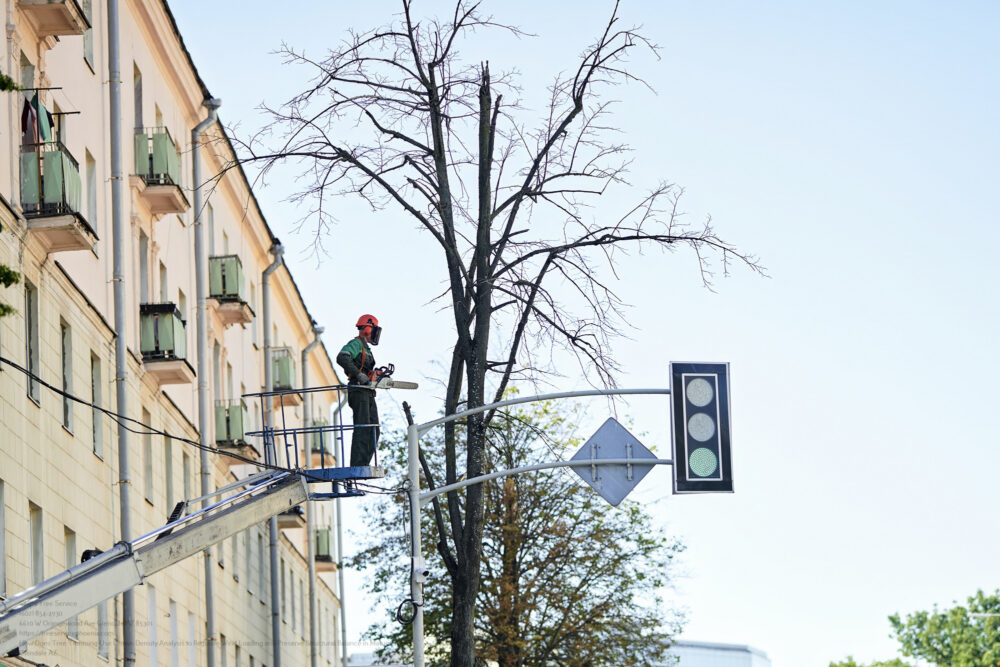
Wind interacts with a tree dynamically. As gusts move through the crown, branches bend, and the trunk responds to shifting forces. A dense crown can present substantial surface area to moving air, while excessive weight toward the outer canopy may increase bending forces on certain limbs.
ISA-published research involving red maple trees found that tested pruning treatments reduced wind load compared with unpruned trees, and the reduction was related to the amount of weight removed. The study also found that crown reduction and thinning changed the center of pressure in the canopy. Other research on live oak found that crown thinning and reduction significantly reduced upper-trunk movement under simulated hurricane-force winds.
These findings don’t mean more pruning is always better. The purpose of tree trimming in Peoria AZ is controlled canopy management. Proper tree trimming and pruning remove growth that creates a specific structural concern while retaining healthy foliage needed for photosynthesis, growth, and recovery.
Need Professional Tree Trimming?
Contact Chips Tree Service today for a professional tree evaluation and dependable arborist-led care.
Why Over-Pruning Can Create a Different Structural Problem
Removing branches simply because a canopy looks crowded can be counterproductive. Trees depend on leaves for energy production, while their internal branch structure supports the distribution of foliage and mechanical loads. Aggressive cutting can remove too much live growth and may leave a tree with an unnatural architecture.
ANSI standard trimming provides a framework for making pruning decisions based on defined objectives rather than on arbitrary appearance. Professional tree pruning may target dead, diseased, damaged, crossing, or structurally weak branches while preserving useful growth.
This is one reason ISA-certified tree climbers and ISA Certified Arborists approach mature trees differently from someone performing basic yard work. Arboriculture involves understanding tree biology, branch attachments, growth patterns, and site conditions.
How Do Arborists Decide What Stays and What Goes?
Professional pruning begins with a purpose. An arborist evaluates the tree’s species, age, crown density, branch attachments, growth direction, defects, surrounding targets, and exposure before determining which branches to remove. Proprietary tools may assist with difficult work, but specialized equipment doesn’t replace arboricultural judgment.
This approach is also why property owners should distinguish between professional tree services and unrelated landscape work. Chips Tree Service focuses on arboriculture while also serving landscape and property management communities. Other landscape contractors, including businesses, may provide broader landscape services, but tree work, including structural pruning, should be approached according to the specific needs of the tree.
Similarly, services such as land and lot clearing, site preparation, land grading, structure demolition, weed removal, yard cleanups, hardscape installations, fake grass, and commercial landscape improvements serve different project objectives. They may occur alongside tree work on a larger property project, but they shouldn’t be confused with crown-density analysis.
What Other Tree Conditions Can Affect Structural Balance?
Crown density is only one part of the picture. A Palm Tree, for example, has a very different growth structure from a broad-canopy shade tree, so palm tree trimming requires species-specific knowledge. Likewise, a tree affected by insects, disease, poor soil conditions, or root damage may require treatment beyond routine pruning.
Tree maintenance can include scheduled inspections, tree health assessments, tree pruning, Tree Care, and corrective work based on changing conditions. In other cases, a property may require tree removal, followed by stump grinding and debris removal. These decisions are best made after considering the tree’s condition and the property’s long-term needs.
For commercial landscape managers, maintaining mature trees can also preserve a property’s appearance and usability. For homeowners, careful tree care can preserve shade, curb appeal, and valuable established vegetation. Good customer service should therefore include clear explanations of what the tree needs and why.
Why Choosing Chips Tree Service Is A Smart Choice
Crown density analysis provides arborists with a practical way to understand how foliage and branch mass are distributed and how these characteristics may interact with wind. When combined with tree risk assessments, tree health assessments, local weather knowledge, and appropriate pruning practices, it can help guide more precise decisions.
Property owners shouldn’t assume that every large or dense tree needs aggressive cutting. They also shouldn’t wait for a branch failure before requesting professional advice. With regular tree maintenance and informed seasonal planning, concerns can often be identified when more options are available.
For Phoenix-area properties, Chips Tree Service provides arborist-led solutions backed by local experience, professional equipment, and ISA Arborist Certification. Whether a tree needs scheduled maintenance, structural pruning, cabling and bracing, or a larger tree care project, an informed assessment provides a better starting point. For property owners searching for tree trimming in Peoria AZ, professional crown analysis can help protect mature trees while managing the structural challenges created by wind and Arizona’s demanding climate.
Need Professional Tree Trimming?
Contact Chips Tree Service today for a professional tree evaluation and dependable arborist-led care.
FAQs About Tree Trimming in Peoria AZ
Connect With Us
Phone: (602) 854-4930
Location: 6610 W Orangewood Ave Glendale, AZ 85301
Socials: YouTube